World Physics and Thinkers
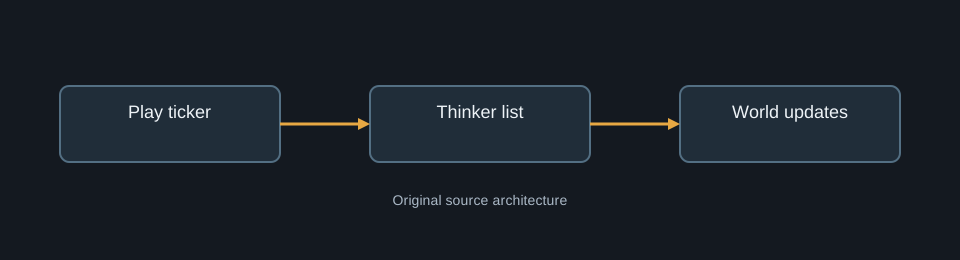
Doom’s runtime world is advanced through thinkers, a common update mechanism declared in d_think.h and managed in p_tick.c. Movers, monsters, projectiles, doors, platforms, and related dynamic entities register behavior that is executed during the play tick, rather than being driven by one enormous switch over every possible object kind.
p_mobj.c handles mobile objects, or mobjs, including spawning, movement, and state progression. Collision and line interactions are distributed across files such as p_map.c, p_maputl.c, p_inter.c, and p_sight.c; special map behavior, including floors, ceilings, doors, plats, and lights, is represented in the corresponding p_*.c systems.
A bounded world model
The map representation provides sectors, linedefs, sidedefs, vertices, and things, while the play code interprets them as a changing simulation. An attempted movement is therefore not merely a coordinate addition: it queries blocking lines, other mobjs, floor and ceiling constraints, special-line crossings, and possibly damage or pickup interactions. The apparent simplicity of a Doom monster walking down a corridor is the result of several local systems agreeing on the result of that movement.
Following a feature from P_Ticker into its thinker and then into collision or special-line code is generally more reliable than searching for a monster or door by name. The engine is organized around update responsibilities, not around a single object-oriented class hierarchy.